





Blog posts
The world needs more energy. Agentic AI can help meet the challenge.
Welcome to Field Notes, a series tracking Tapestry’s progress as we deploy AI across the electric grid. This edition chronicles how The largest regional electric grid operator and power market in North America. is using HyperQ, one of Tapestry’s AI-powered interconnection acceleration solutions, in the Application Review phase of its reformed Cycle 1.
The latest updates will appear at the top.

Cat Wong
Head of Power Systems and Technical Operations

Robin Louvet
Data Science Lead
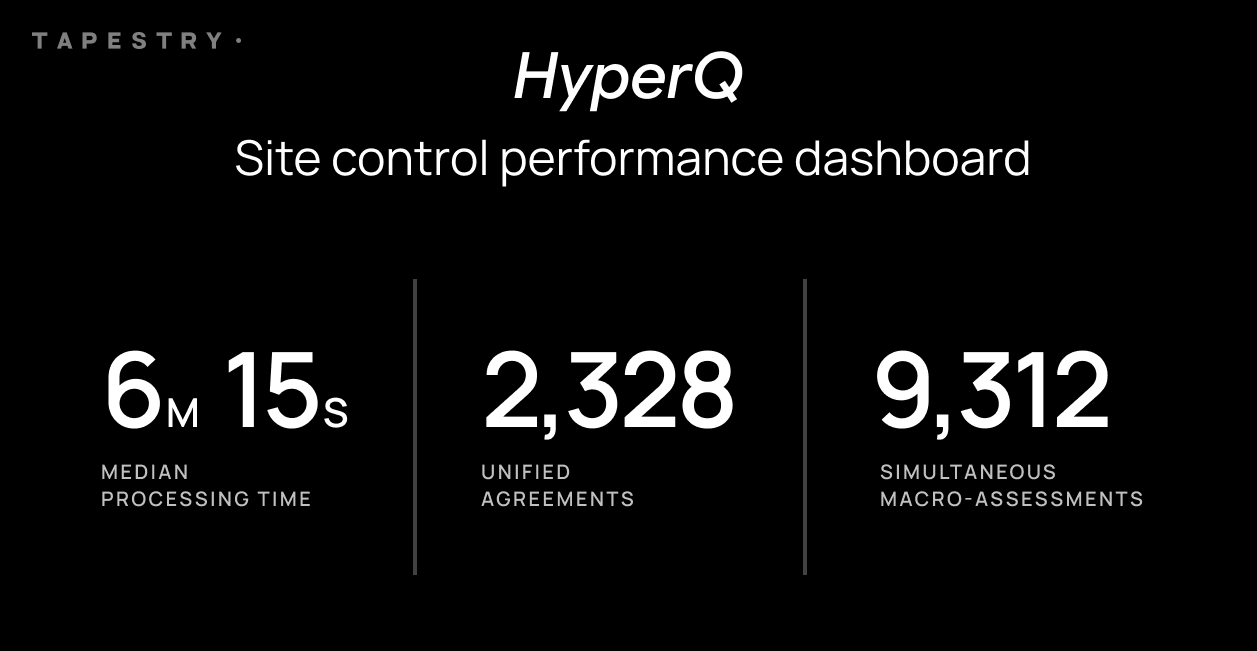
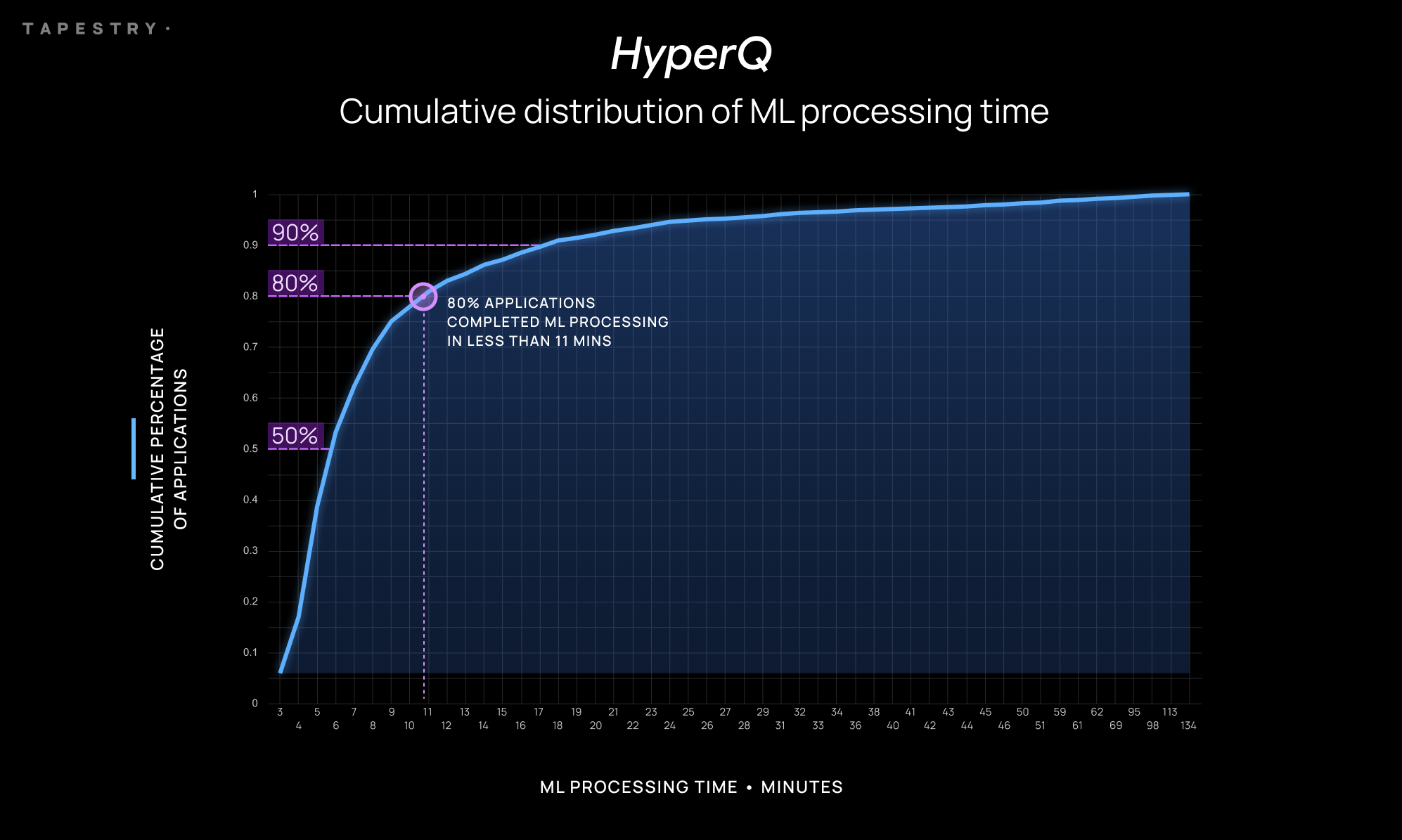
Tapestry’s HyperQ successfully completed the initial processing layer for the site control portion of PJM’s newly reformed Cycle 1, executing 9,312 parallel application reviews and readiness assessments across 811 generation applications at a median Pure computational processing duration, excluding internet transmission lag. of 6 minutes and 15 seconds [1].
Evaluating site control within modern transmission networks requires two distinct steps: an initial Application Readiness Review against rigorous tariff requirements, followed by a final compliance determination under An independent entity managing the power grid and regional wholesale market. guidance. HyperQ executes intensive document-ingestion and An AI's capability to process different data formats (text, images, maps) at once. analysis tasks, delivering a centralized site control Application Readiness Report with precise page-level citations to support grid engineers as they perform the final determinations. In its first live deployment, the tool achieved a Statistical metric showing 95% of tasks finished at or below this timeframe. of 28 minutes, demonstrating a predictable processing distribution for verification timelines even when handling complex, data-heavy applications.
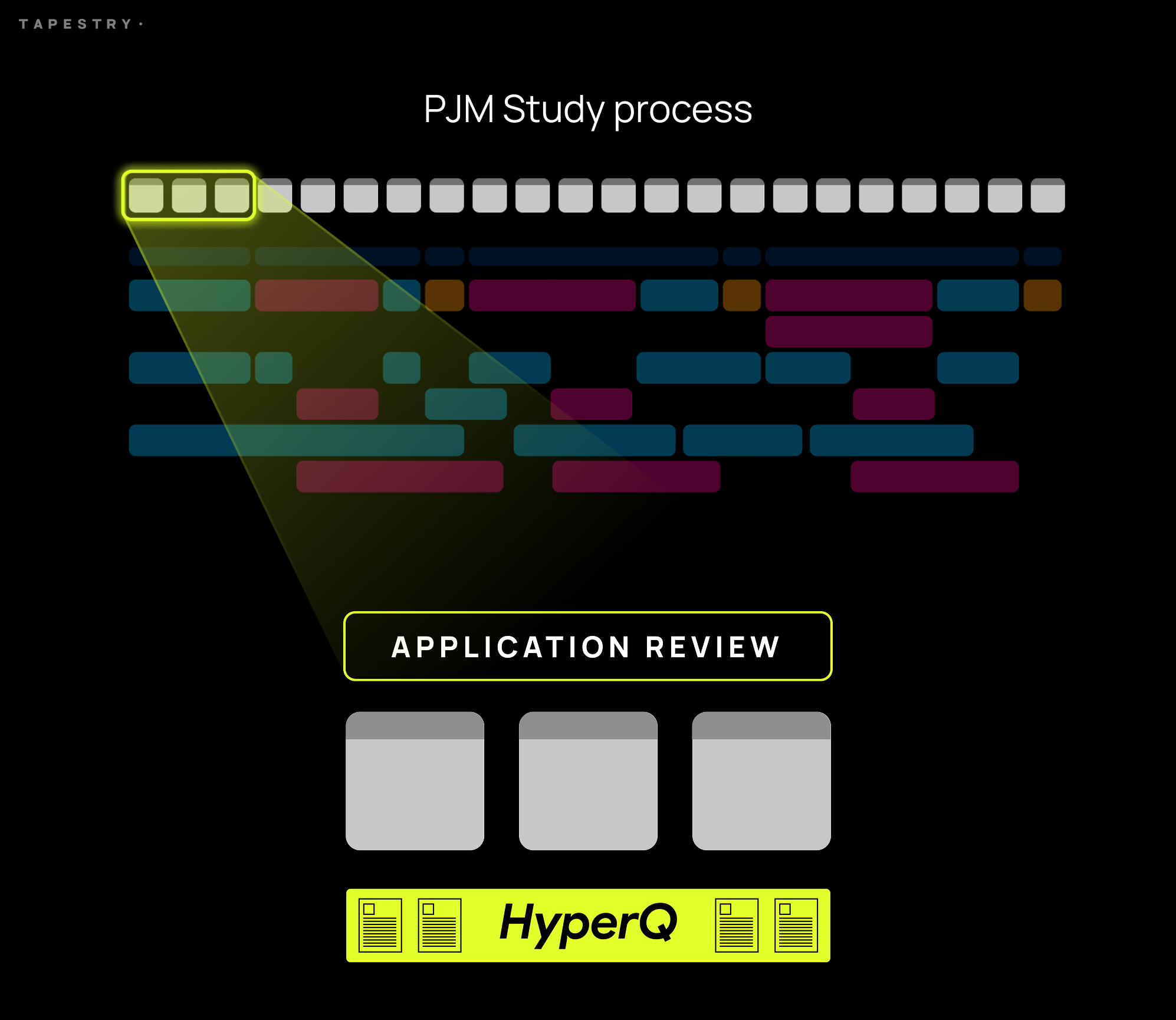
This operational velocity is critical because PJM's reformed cluster process introduces two systemic constraints: compressed timelines and a strict "first-ready, first-served" framework that elevates site control to a primary gatekeeper node. In Cycle 1, PJM is managing an unprecedented surge, processing 811 generation applications representing massive potential capacity while staff concurrently handles other phases in legacy queues. According to Tapestry’s customer research into traditional regional transmission organization (RTO) workflows, a traditional, manual site control Application Readiness Review has historically required multiple hours of evaluation per application, scaling higher for more complex applications due to the constraints of sequential human review [2].
HyperQ's parallel processing compresses this initial screening window down to minutes per application. By evaluating computational runtime against historical baselines, HyperQ demonstrates a 20x+ acceleration for the site control portion of the Application Readiness Review phase across similarly complex cohorts. This structural velocity predictably flattens the timeline and reduces the linear administrative bottleneck when hundreds of projects drop simultaneously [3].
As application volumes rise to meet escalating energy demand, grid operators face unsustainable surges that—without scalable technology—require linear expansions of manual effort and processing timelines. HyperQ addresses this challenge by providing an AI-assisted solution that can scale for modern grid administration. Drawing on Stanford economist Chad Jones’s research regarding systemic “weak links,” HyperQ targets one of the primary upstream bottlenecks of the interconnection application process with agentic AI acceleration.
As a result, the system can isolate non-viable projects early, preventing them from cascading downstream and reducing administrative friction across the full lifecycle. This streamlined review process will allow shifting additional focus to improving the ability of grid operators to examine improvements to other aspects of application processes.
While Tapestry's approach to comprehensive interconnection reform remains a multi-layered effort, HyperQ’s deployment serves as the industry’s first baseline validation of agentic AI performing at the scale required for the largest and most complex electricity market in North America.
Footnotes
The length of the interconnection process is one of the most binding structural constraints on the modern electrical grid. Legacy processes have struggled to match the reality of unprecedented load growth, as engineers spend months painstakingly combing through applications by hand while surging demand outpaces the interconnection of new generation resources.
Tapestry demonstrated how agentic AI can streamline initial data processing and perform complex, multi-layered compliance analysis at scale
PJM Interconnection, North America’s largest wholesale electricity market and grid operator, recently initiated Cycle 1 of its newly reformed A waiting list of energy projects seeking to connect to the power grid.. This transition shifts PJM’s process from “first-come, first-served” to “first-ready, first-served” and represents an operational evolution, scaling to meet unprecedented application volumes within accelerated timelines. To assist in validating site control—the foundational prerequisite of ensuring applicants have control over the land parcels where they plan to build generating facilities and interconnect with the grid—PJM deployed Tapestry’s HyperQ.
The magnitude of HyperQ’s deployment highlights the operational stress confronting modern grid administrators. PJM’s Cycle 1 encompasses 811 generation applications, representing 220 GW of potential The maximum amount of electrical power a power plant can generate at a given time.. To put this into perspective, the entire existing, installed The maximum theoretical power output a generator is designed to output. of the PJM grid—built out over nearly a century of utility engineering—stands at approximately 180 GW. PJM operators must ingest, sort, and validate a larger volume of potential generation capacity than exists across their entire transmission footprint today, in just a few weeks.
Tackling this historic surge in application volume under a highly compressed calendar timeline, HyperQ successfully executed 9,312 parallel tariff readiness assessments at a median algorithmic processing speed of 6 minutes and 15 seconds. This means HyperQ simultaneously compared the site control provisions in new applications against the region’s tariff rules and user manuals, analyzing and flagging deficiencies so that the operator’s expert reviewers can focus on final determinations.
Establishing site control is the critical baseline of the entire interconnection pipeline; if developers cannot secure the proposed land, subsequent infrastructure modeling and technical studies cannot proceed effectively. PJM’s live deployment of HyperQ signals a scalable approach for queue administration at large, demonstrating how an intelligent software layer can synthesize and pre-validate massive amounts of data across sprawling portfolios of disparate real estate agreements.
This shift toward concurrent computational review provides an operational model for navigating the current energy boom, supporting finite human resources as they handle expert legal and engineering decisions.
The U.S. Federal Energy Regulatory Commission (FERC), which oversees regional electricity markets like PJM, originally designed its open-access transmission framework in 1996 to manage what was then a lower-frequency stream of interconnection applications for centralized power plants. During that era, PJM received fewer than 15 requests annually, and the entire U.S. saw only a few hundred requests a year.
The generation mix has evolved since then; today, operators must navigate retirements of those large, centralized resources as well as an influx of distributed resources and inverter based resources. Increased complexity means every application requires checking fragmented property deeds and independent mandates against strict Open Access Transmission Tariff (OATT) criteria.
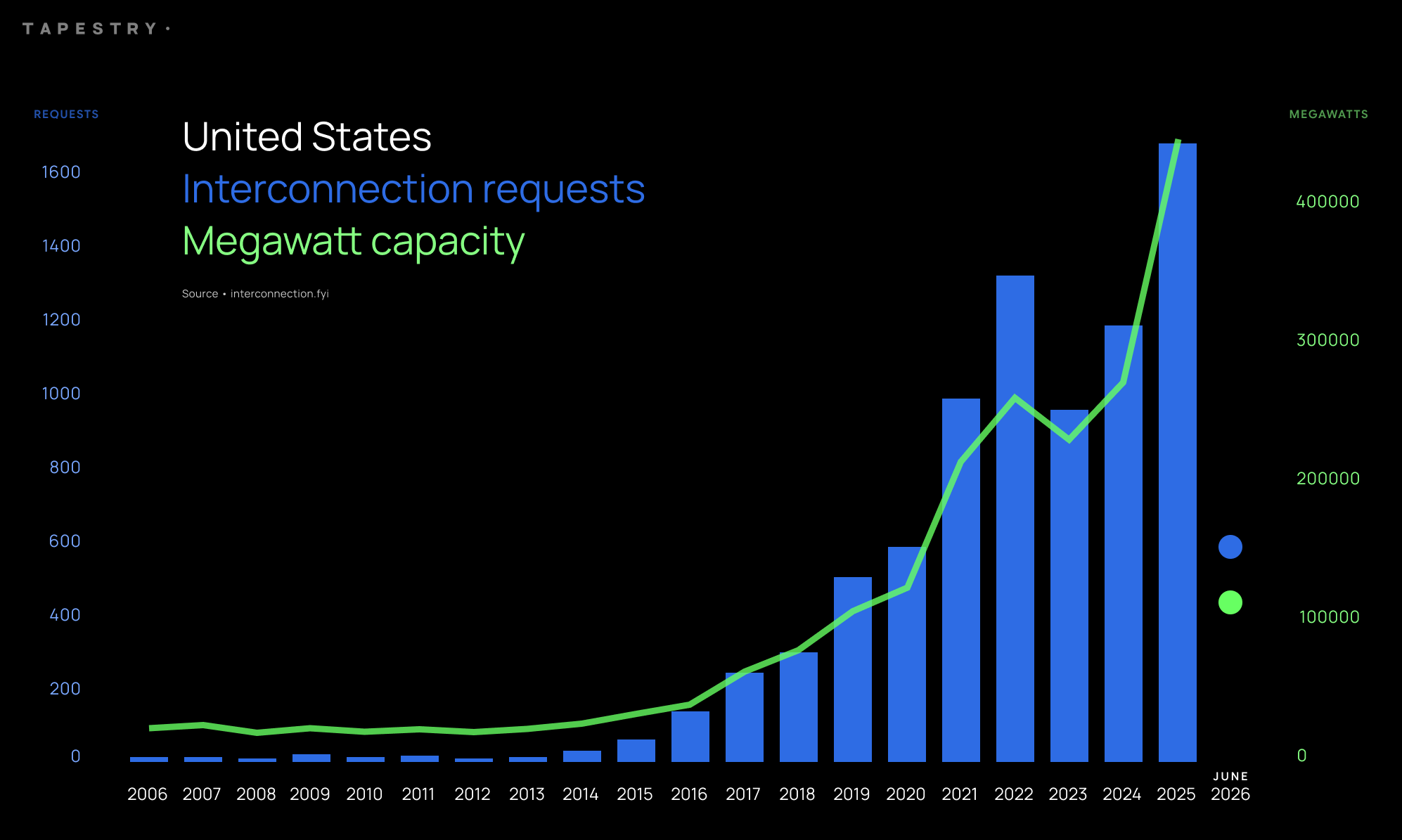
To keep pace with this evolution, the industry has fundamentally shifted from the legacy “first-come, first-served” serial process to a “first-ready, first-served” cluster framework, outlined in FERC Order 2023. Many regional operators' transition cycles entail their own queue reform, making site control data readiness a prerequisite before an asset can advance to interconnection to the physical grid.
To maximize systemic efficiency, HyperQ targets site control validation as its primary "Gatekeeper Node." This strategic sequencing focuses agentic capabilities to what Stanford economist Chad Jones identifies as the system’s most crucial ‘weak link’. By eliminating early structural vulnerability, HyperQ prevents manual backlogs from compounding downstream.
When parallel AI agents tackle the primary compliance gate first, the system isolates non-viable projects before proceeding onto more technical reviews.
Prioritizing this specific phase relies on three core operational principles:
HyperQ’s site control pre-validation functions as an intelligent software layer purpose-built for complex legal and structural reasoning, designed to absorb the grid's data-intake constraints. Tapestry's high-throughput architecture deploys a distributed, multi-tiered workflow of specialized AI agents capable of navigating information-dense regulatory and technical submissions.
Overcoming linear human constraints, the system architecture relies on four primary engineering pillars:
Early user feedback from engineers confirms that providing these direct, page-level citations significantly streamlines manual engineering reviews, removing the traditional administrative burden of hunting through dense documentation to verify application data.
Data security forms the structural foundation of HyperQ’s intake pipeline. The system enforces an isolated, U.S.-based secure data perimeter governed by VPC Service Controls, ensuring all data ingestion, processing, and localized document indexing occur exclusively within a hardened perimeter. This strict isolation restricts access entirely to authorized personnel and ensures full compliance with Personally Identifiable Information (PII) and Critical Energy/Electric Infrastructure Information (CEII) data custody standards.
Perfecting HyperQ’s architecture—which deploys Google’s multimodal Gemini models within a guided agentic workflow—for a high-stakes, active regional transmission operator (RTO) environment demanded a rigorous period of foundational field testing. Tapestry engineers spent 10 months collaborating with PJM’s team to map out a precise compliance baseline, translating intricate tariff rules into a deterministic instruction set for the system’s control logic.
Their iterative development process required going beyond the “letter of the law” in official tariffs to capture the “case law” in practice, requiring nuanced historical knowledge, real-world edge cases, and expert judgment calls that standard rule-based software cannot handle. Crucially, this initial phase established a repeatable implementation playbook designed to streamline and accelerate deployment across other global energy markets. Data verification challenges and application volume surges are universal challenges, and HyperQ’s core architectural foundation is uniquely built to scale across these varied regulatory environments.
Dense interconnection materials strain the standard attention limits of AI models. The team resolved this by developing a specialized context-chunking strategy that mirrors a senior project manager's workflow, programmatically distilling raw, heterogeneous filings into focused sub-tasks to prevent context loss.
To directly mitigate real-world Observed shifts in patterns / statistical distributions for a dataset. , HyperQ underwent an intensive, iterative “hill climbing” optimization process that systematically refined its performance. Utilizing a dataset of 234 historical queue submissions, this exercise exposed HyperQ’s underlying engine to a fragmented mix of legal agreements, unstandardized property deeds, and varied PDF formats. By evaluating the system against these historical cases, engineers successfully executed instruction optimization—refining the agents' specific guidance and The maximum amount of data an AI model can read and process during a single invocation. to maximize reasoning accuracy across complex real-world variables without altering underlying model weights.
The team executed an intensive regimen of systematic prompt optimization and task alignment and ran thousands of automated evaluations against specific Term, Conveyance, and Exclusivity tariff requirements in order to finalize the architecture. This deep optimization successfully codified decades of domain expertise, aligning parallel macro-assessments with subject matter experts. As a result, HyperQ now delivers predictable, production-ready assessments across 99% of applications in under an hour.
HyperQ successfully streamlined the initial Application Readiness Review for site control in PJM’s Cycle 1 by programmatically isolating and synthesizing 4,581 raw site control documents into 2,328 legally coherent agreement bundles at unprecedented speed.
Processing these files required extracting and cross-referencing a dense matrix of legal and spatial logic. Each of the 2,328 generated bundles was evaluated against four non-negotiable Open Access Transmission Tariff (OATT-defined) site control elements, yielding a total of 9,312 distinct macro-assessments executed across the cohort after accounting for immediate structural exceptions:
Historically, evaluating these interlocking parameters has been strictly linear: analysts manually trace a decision tree one page, one clause, and one document at a time. Attempting to resolve the resulting 9,312 distinct macro-assessments creates a significant challenge for traditional manual workflows trying to scale.
Managing thousands of interlocking, dependent variables simultaneously is cognitively impossible for human reviewers; the sheer density of the cross-references guarantees critical path delays and information degradation. HyperQ bypasses this sequential barrier through two-dimensional parallelization, processing multiple applications horizontally while simultaneously evaluating dense, multi-layered decision trees vertically across pages.
Beyond compressing immediate time-to-insight, an agentic system architecture alters the scaling economics of the queue intake process. In standard administrative workflows, managing massive surges in volume across multi-year cluster study cycles introduces severe institutional memory challenges. When queue cycles are staggered, specialized engineering knowledge and administrative edge-case precedents can easily become siloed or lost between active application windows, requiring repetitive team onboarding and alignment sessions to reset baseline operational standards.
HyperQ resolves this structural drift by permanently codifying domain expertise directly into the platform’s core task parameters. Because the software's underlying logic is optimized continuously, every unique edge case resolved or system refinement implemented yields permanent, compounding gains in operational capability. Rather than expending finite organizational energy just to maintain baseline functional parity from one queue cycle to the next, grid operators can permanently institutionalize complex regulatory logic, ensuring identical, uncompromised verification standards regardless of surge volumes or chronological gaps between cluster windows.
Anchoring reviews in a fixed instruction set establishes a standardized, neutral data-intake filter. HyperQ applies the exact same programmatic compliance rules across an entire batch of applications. Ultimately, the system eliminates the grueling manual search for signature blocks and execution dates to surface the exact data points requiring verification, freeing up expert engineers to make the final determinations.
While verifying site control data is structurally separate from downstream physical engineering studies, stabilizing the entry point ensures the integrity of the entire pipeline. In the coming months, HyperQ will expand to complex electrical data reviews, a phase that currently requires a time-consuming, labor-intensive, and costly manual review by engineers and consultants. By replicating the same proven automation framework used for site control, HyperQ will be able to programmatically audit A simplified schematic blueprint mapping out a project's electrical layout. and equipment parameters, isolating configuration anomalies before they corrupt additional grid models.
As its processing infrastructure builds outward, HyperQ’s underlying tech stack will evolve to handle the sheer scale of global network complexity. Future iterations of the tool will migrate to Google’s code-first Agent Development Kit (ADK) framework, driven by a graph-based runtime optimized for the extreme concurrent throughput required by subsequent study cycles.
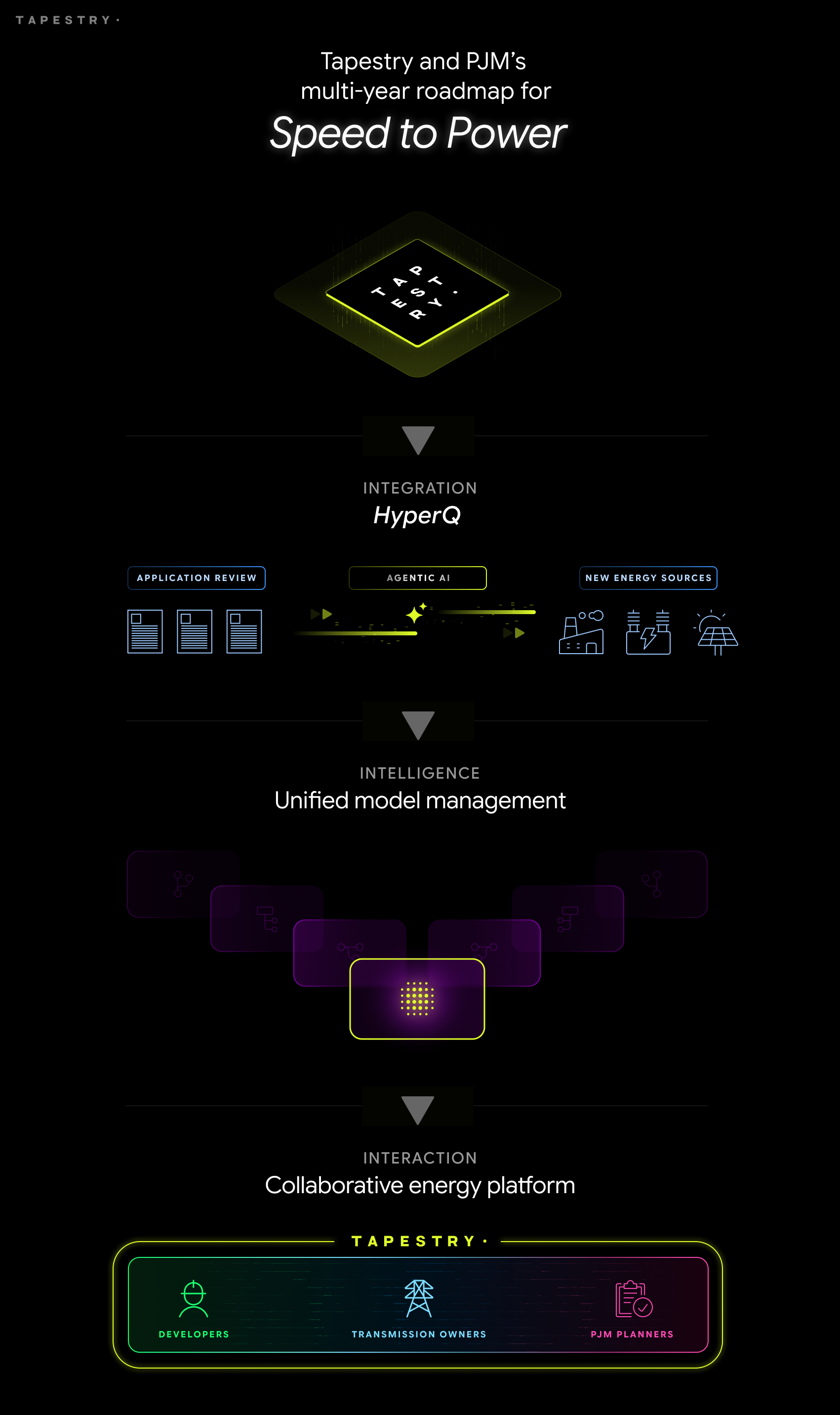
Establishing a clean ingestion protocol lays the critical groundwork for Tapestry’s Unified Model Manager: a novel system that weaves siloed, disparate grid models and data into the first unified, interactive model of the electric grid. This definitive, shared source of truth will allow planners, operators, and developers to execute decisions against a perfectly synchronized grid model, shifting the paradigm from reactive, snapshot-based workflows to active grid orchestration.
Though no single piece of software can act as a total silver bullet for the multi-phased interconnection queue, embedding Tapestry’s tooling within Cycle 1 demonstrates how the initial, data-dense phases of grid administration can be managed with algorithmic precision. To further optimize this entry point, Tapestry also aims to extend HyperQ access directly to the developer community. Providing a transparent interface to pre-validate applications will allow developers to identify and resolve compliance and readiness criteria prior to formal submission.
The operational complexity and regulatory density of North America’s largest electricity market provides the real-world telemetry needed to systematically refine our models. As we iterate alongside grid operators and engineers, HyperQ’s collaborative architecture serves as an evolving blueprint: one that will continuously expand its capabilities to optimize transmission capacity, adapt to changing market rules, and accelerate the transition to a modern grid infrastructure worldwide.

General Manager
A longtime leader in the energy space, Page bridges technical depth and commercial execution across physical infrastructure and frontier technology. Prior to Alphabet, she built a track record scaling high-growth energy startups, including as co-founder and CEO of Clarus Power. She held leadership roles in both go-to-market and commercial innovation at SunRun, helping steer the company’s growth through its initial public offering. A co-inventor on multiple U.S. energy patents, Page serves on the Washington Post’s Intelligence AI & Tech Council and the Santa Clara University Tech Ethics Council.

Head of Technical and Partner Operations
Andy is an internationally recognized expert in electricity market design and power system operation. Prior to joining Tapestry, he served as President and CEO of PJM Interconnection, the largest power grid in North America and the largest electricity market in the world. He has extensive experience in power system engineering, transmission planning, applied mathematics, electricity market design, and implementation. Andy is an IEEE Fellow and an Honorary Member of CIGRE, and he served as co-chair of the Energy Transition Forum for 8 years.

Head of Engineering
An expert in large-scale data processing and analytics, Fayyaz previously held engineering leadership roles at Google, Snowflake, and Salesforce. He has deep experience scaling massive infrastructure and building AI platforms for data-driven decision making. A two-time recipient of the Feats of Engineering Award during his tenure at Google, he also has served as a strategic advisor to several high-growth startups.

Head of Product
Thomas is a product leader dedicated to making complex systems universally accessible. He most recently served as Chief Product Officer at Viasat, transforming a legacy satellite operator into a modern services leader. During his nearly 14 years at Google, Thomas scaled underdog products into flywheel businesses that reach billions of users across Android, Hardware, and ChromeOS. He’s a member of the CPO Council and the UN World Food Programme’s Innovation Advisory Council.

Head of Partnerships
When Aviva isn’t powering up our partnerships, you can find her amped up for a game of pickleball. She is also a fan of electrical grid puns.

Machine Learning Lead
When he's not helping build tomorrow's grid, Nikhil can be found cooking for family and friends, playing cricket, or figuring out which heavy metal songs make the best lullabies for his son.

Head of Power Systems and Technical Operations
Cat balances her passion for technology and leadership with a love for travel and cultural exploration.

Public Policy Lead
Luke spent years navigating energy policy across Capitol Hill, the Executive Branch, and think tanks before joining Tapestry. Now, he’s bringing Tapestry's grid AI tools back to D.C. and beyond. A native West Virginian, he’s most at home skiing or hiking mountain trails.

Technical Program Manager
Cauchy optimizes the engineering experience at Tapestry, streamlining processes and developing tools. When he's not fine-tuning our workflows, he's fine-tuning the sound at local venues as a passionate audio engineer.

Product Manager
Natalie's product management work has her seeking out solutions to speed up the interconnection queue, better manage grid models, and develop a Tapestry platform. She balances her enthusiasm for clean energy with a love of epic backpacking adventures.

Data Scientist
In addition to analyzing data and applying ML to energy problems, Laura loves learning about energy policy and advocating for faster renewable integration. She’s written about VPPs and worked across many areas of the energy sector.

Software Engineer
Victor manages Tapestry's technical infrastructure from xyr lair, occasionally emerging with some baked goods. Xe also aims to bring an AI/ML culture to the team.

Software Engineer
Charlene designs the backend infrastructure to optimize the electric grid at Tapestry, while dedicating her off-hours to optimizing her own health, fitness, and culinary adventures.

Principal Partnerships Program Manager
Colin's professional mission is speeding up grid interconnection. His personal mission? Speeding down mountains on telemark skis and visiting every type of power plant.

Data Science Lead
Robin's career spans global power system software, operator training across continents, and advanced data science. Driven by curiosity, he explores the world and embraces new cultures.

UX Designer
Yihang designs user-friendly products. Her dog, Mili, designs user-friendly cuddles.

Partnerships Program Manager
When Alanna isn’t busy connecting with our partners, she’s busy connecting flights. A café enthusiast driven by equal parts caffeine and curiosity, her appetite for exploration is as boundless as the grid itself.

Product Manager
Tamir leverages broad product and energy expertise to develop Tapestry's tools for accelerating speed to power. He generates his own power when he's on the soccer field or exploring snowy mountain slopes.

Power Systems Specialist
Shengnan is a seasoned power system planning engineer dedicated to building the future grid, where AI both powers and is powered by the grid. When she's not at work, you can find her reading, hiking, snorkeling, or riding roller coasters with her family.

Data Scientist
Leah uses data to find insights for the grid, then packs her bags for outdoor adventures.

Software Engineer
As a software engineer, Veena makes the pieces click into place, fueled by the serotonin high of green check marks and boxes. Otherwise, you'll find her practicing her rock step and stepping on rocks.