A single machine: Overcoming the barriers to grid transformation
Executive summary
For over a decade, the U.S. electric power sector has undergone transformative changes, from the dramatic decline in technology and resource costs to asset retirements and additions and, more recently, significant new demand growth. Electricity demand has grown at a faster pace than in the previous 15 years. U.S. electricity use has increased 2.1% a year on average over the past five years, with that trend forecast to continue through 2050. Interconnection queues for generation have also grown in number of projects and duration, reaching a median process time of 61 months in 2025.
Policymakers and regulators at every level of government have successively enacted policies to respond to changing circumstances and shape the power sector. In the past several years, Congress has frequently taken up permitting reform, most recently releasing text this September. In June, the Federal Energy Regulatory Commission issued several orders directing the six grid operators under its jurisdiction (and their respective transmission owners) to evaluate whether changes are needed to their interconnection and planning processes in light of new load growth.
With such transformations occurring across the electric grid, its planners, operators and other participants have long needed software, data and computational tools to direct that change toward better outcomes for the grid without compromising its reliability and security. Those analytical tools are now at hand, and realizing their full potential requires clearing the barriers to communication and collaboration among the many actors doing that work.
Many of the challenges facing grid planners and operators start with grid data. Useful data must be complete, accurate, current, accessible, interoperable and secure. But much of what circulates today misses at least one of those marks. Due to reliance on sequential information sharing and editing, often in manual processes, data missing these attributes creates problems that multiply across the planning process. Grid actors work across separate models, tools and records, so coordinating studies and holding a current, shared view of the system takes effort at every step. A correction may not reach the underlying record or every related case. Planners have to find and resolve the same discrepancy again in the next cycle.
Modernizing the grid is a relay race. Data harmonization goes beyond speeding up any single leg and enables engineers not just to sprint but to pass the baton across current barriers to information flow and communication.
Tapestry envisions a collaborative environment in which authorized participants work from a version-controlled model rather than disconnected copies. A unified platform will improve coordination among developers, utilities, policymakers, equipment manufacturers, investors, service providers, and grid planners and operators. And it will support stronger data integrity and help apply advanced study and planning tools at a larger scale.
A platform like that can help grid planners and operators respond to the need for faster, better-coordinated studies of new loads, generation and transmission needs without compromising reliability and security. Potential legislative changes or regulatory responses and resulting tariff revisions will set the policy terms for the electric grid going forward. Delivering on those terms depends on conditions the industry has not built yet at scale: data that reaches the right engineers and relevant stakeholders while it is still current, the right computational tools to make use of it and day-to-day procedures that turn a tariff change into a changed study.
Introduction
In its nearly 150-year history, the U.S. electric grid has built up a level of operational and planning complexity that has required compartmentalization, both to visualize and to manage it. It spans subsecond to multidecadal time scales, continental geographies, and equipment counts in the tens of thousands: over 525,000 circuit-miles of transmission, nearly 27,000 operable generating units, over 2,500 synchrophasors, and more. The challenge is not just the size of the grid, but the combinatorial complexity created by connecting “millions of generators, control devices, and loads” in this way.
The grid is “a single machine,” but it doesn’t yet act like one.
Grid planning, management and operational activities and tools exist in silos within and among organizations. Decisions and workflows rely on data that must cross those silos but often updates asynchronously, losing details and accuracy as it moves from individual assets to zonal levels. This complexity and lack of fidelity were manageable, even sensible, while demand was flat, but the grid is now turning sharply into a period of dynamic growth driven by large loads, electrification, a shift from an inertia-dominated network toward an increasingly electronics-driven one and other changes.
The status quo grid does not meet current or future needs with the necessary speed and information integrity, and status quo solutions will not fix it for our future.
Under that strain, interconnecting any resource or demand into the power grid has already become a divided and laborious enterprise, frequently complicated by speculation, errors and manual vetting processes not meant to run at today’s volume. Costs have mounted, timelines have gone from two to five-plus years, and administrative and technical checks that were once clearinghouses for project approval have become sources of uncertainty. The balkanization of grid data has obscured the physics of the grid and limited the ability of operational insights to inform planning and analysis.
Static rules aren’t keeping up with dynamic growth. In response, FERC recently directed grid market operators, or regional transmission organizations, to evaluate whether changes are needed to their interconnection and planning processes in light of new load growth. Its June orders call on grid operators to better integrate large loads alongside generation in their planning, studies and interconnection processes, assess and adopt new technologies that enhance services and transparency, and move faster to meet the moment. Similarly, Congress has recently released bill text, including measures that would affect transmission and the grid.
Meeting policymakers’ calls to action is achievable.
In the coming years, the electric power sector can adopt the reforms policymakers have outlined by embracing the computational tools that enable their implementation, provided we tackle the remaining barriers to collaboration and data exchange underpinning grid analysis and planning. Drawing on its deep technical expertise, Tapestry wants to make clear that the technologies needed to implement transformative change for the electric grid already exist or are in active development. By removing obstacles to collaboration and transparency, making complex grid analytics legible and actionable, shortening timelines and keeping the reliability and security standards that make safe operation possible, we can build a more resilient and affordable grid.
The complexity of the grid is a function of its historical growth
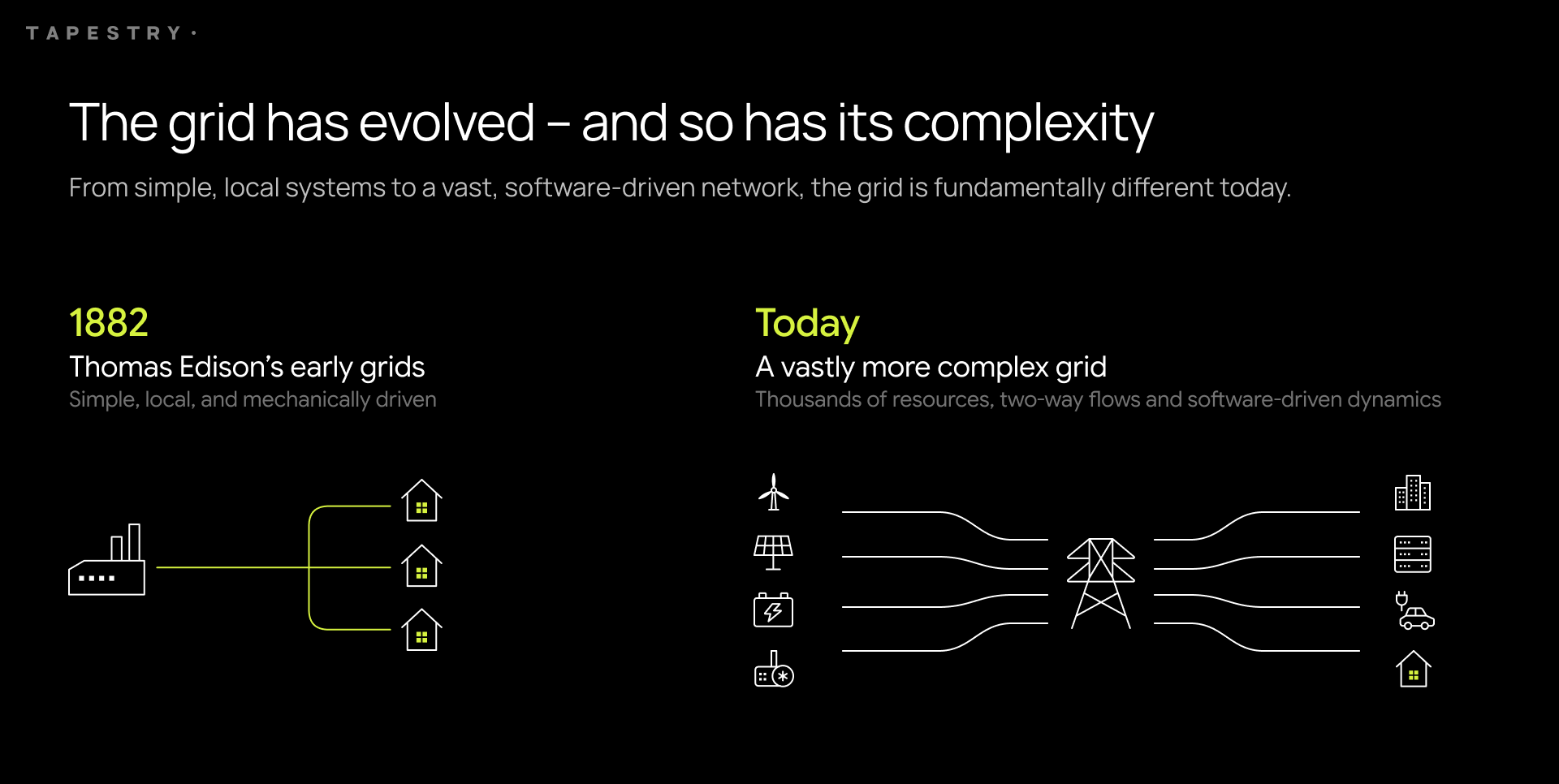
In 1882, Thomas Edison built the world’s first grids in London and New York City using coal-fired dynamos to generate and distribute electricity for lighting. Inertia-based generating units dominated grid architecture for its first 120 years, providing a reliable planning and operational model, relatable policy frameworks, affordable service to customers and dependable returns on investment. Their mathematical foundation also presented engineers with straightforward calculations, solvable in reasonable timelines.
Where Edison built a microgrid through quick, on-site adjustments, modern engineers face thousands of times the complexity, tracking down information from other grid participants only to spend weeks running heavy computational models for a single cluster of project applicants. Those models are mathematical representations of the grid that engineers solve before anything gets built to show the system will operate safely and reliably under various conditions. Conventional generators follow well-established physical equations, and inverter-based resources depend on control code that models often must represent in greater detail. This shift in mathematical difficulty reflects the massive growth of the physical grid and its components and the move toward power electronics-dominated networks that lack mechanical inertia and rely on software code to drive response to events. As software and data have become more fundamental to grid operations and planning, some power electronics models have drifted from the grid’s physical reality, relying on equivalencies and aggregations. More standardization is required to ensure analytical formulas correctly reflect grid response reality.
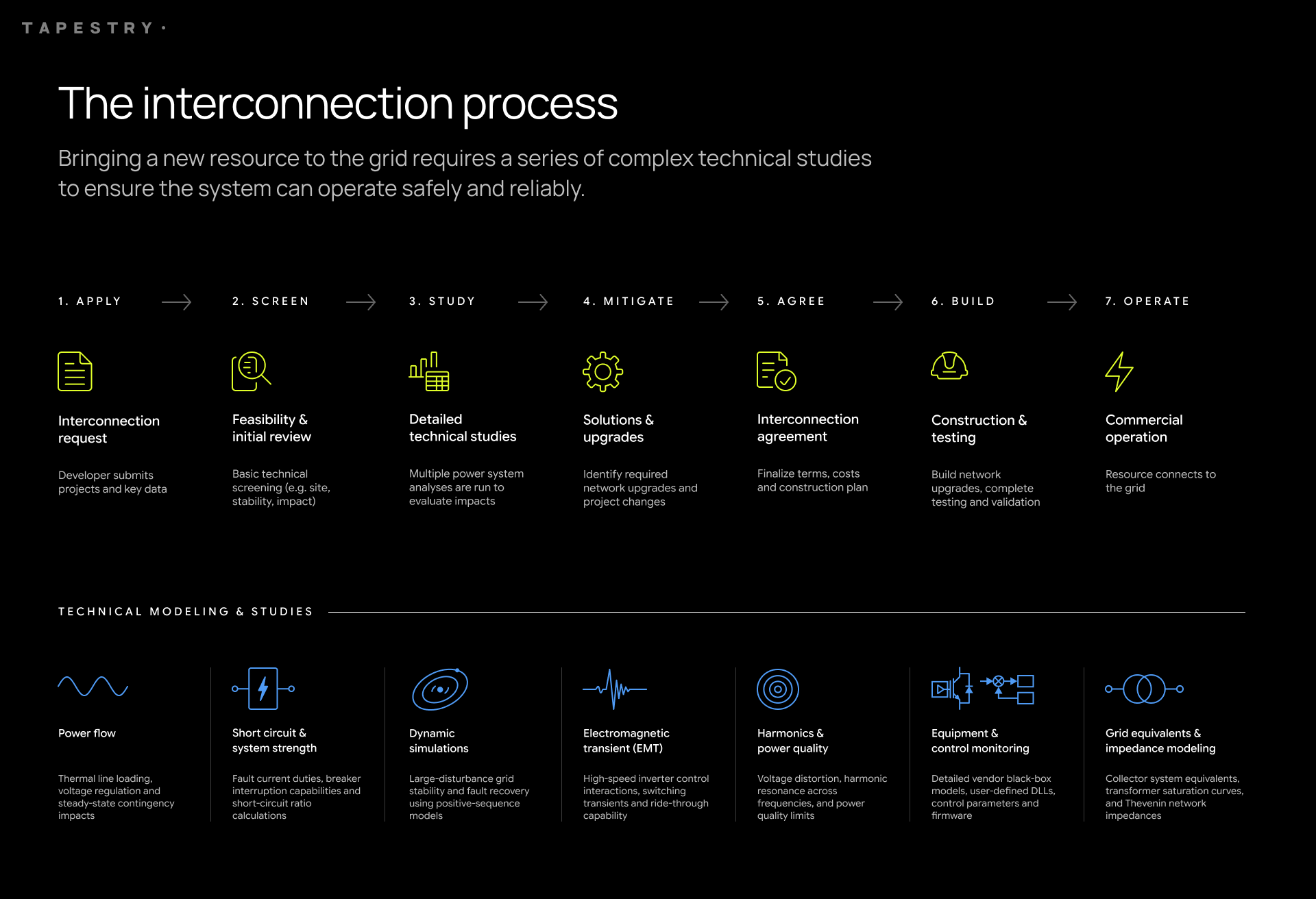
The grid’s analytical layers, from real-time operations through long-term planning horizons, reveal the immense quantity and quality of data available to its engineers and the increasing effort needed to manage inputs and outputs across the system. Taken together, these analyses exceed what planning teams can complete manually or with conventional computing power. They require high-fidelity data, more complex calculations and computational tools to evaluate the growing number of applications, potential violations and scenarios in a reasonable timeframe.
Today, regional transmission organization operations planning engineers and control room operators maintain grid reliability and clear wholesale markets through a coordinated hierarchy of analytical software. Operations planning engineers assess day-ahead and look-ahead reliability using real-time contingency analysis for N-1 conditions, screen scheduled outages against post-contingency N-1-1 limits, evaluate dynamic stability, monitor subsynchronous oscillation risks, verify short-circuit breaker duty and calculate available transfer capability.[1] In the control room, operators use security-constrained unit commitment and security-constrained economic dispatch. These engines are underpinned by seconds of supervisory control and data acquisition telemetry, subsecond synchrophasor time series data streams, node-breaker bus topologies, cyclically solved state estimator models, dynamic line rating sensors, generator bid curves, transmission outage schedules and weather forecasts. Interconnection planning requires specialized study engineers to execute several analyses:
- Feasibility, facility and system impact studies.
- Deliverability assessments.
- Weak-grid short circuit ratio screenings.
- Harmonic resonance evaluations.
- Dynamic and subcycle electromagnetic transient simulations to detect inverter-based control interactions and ride-through vulnerabilities.
Many of these analyses rely on the control parameters and detail models provided by original equipment manufacturers, often tuned during field commissioning, as well as phase-locked loop firmware, black-box compiled dynamic link libraries, collector system impedances, transformer saturation curves, Thevenin equivalents at point of interconnection and standardized positive-sequence dynamic models.
Finally, in the long-term transmission expansion and planning horizon, engineers stress-test regional reliability and economic efficiency through 8,760-hour chronological production cost modeling, probabilistic loss of load expectation resource adequacy assessments, alternating current power flow transfer limits, dynamic reactive reserve margin analyses and extreme-event resilience screening under North American Electric Reliability Corp. transmission planning standards. These planning analyses may also incorporate 10- to 20-year spatial electrification and load forecasts, regulatory policies, historical meteorological and renewable generation profiles, generation retirement schedules, battery degradation profiles and throughput curves, fuel price projections, regional market hurdle rates, geographic information system environmental or routing constraints and critical energy infrastructure information-governed network base cases.
The changes to the grid in the last five years have been exponential, not linear
The needs facing our national grid have never been greater: infrastructure needs are changing, markets and policies are responding to those needs, and technological innovation is meeting those changing circumstances and outpacing legacy processes that have defined grid planning and analysis for decades. After roughly 15 years of flat consumption, the U.S. Energy Information Administration reported that electricity demand rose an average of 2.1% per year over the past five years and projected growth of 0.9% to 1.6% annually through 2050. The Department of Energy’s Lawrence Berkeley National Laboratory projects that data centers could consume 649 terawatt-hours in a single year by 2030. Simultaneously, other sectors make up electricity demand and drive its growth: non-data center electricity use in the commercial and industrial sectors makes up the majority of U.S. demand (over 55%). The International Energy Agency has projected electricity demand growth from the electrification of buildings, transportation, and manufacturing since before 2022. Using NERC forecasts, LBNL estimates non-data center load could add 926 TWh over the six years between 2024 and 2030.
At the same time, supply and transmission development are not keeping up. In its Long-Term Reliability Assessment, NERC found that 13 of 23 assessment areas face resource adequacy challenges over the next decade. Generator interconnection queues remain a bottleneck. DOE’s draft National Transmission Needs Study from July 2026 finds that transmission congestion occurs across “all” regions and cites studies estimating that approximately 4,000 circuit-miles of transmission will need to be replaced each year for the next few decades to meet the nation’s demand, at a cost of approximately $10 billion per year. Likewise, LBNL estimates that as of the end of 2025, roughly 8,200 projects were waiting to connect to the grid, representing 1,312 gigawatts of generation and about 740 GW of storage. The median process time for projects moving from interconnection request to commercial operation reached 61 months that year, up from 22 months in 2008, not including the subsequent construction time.
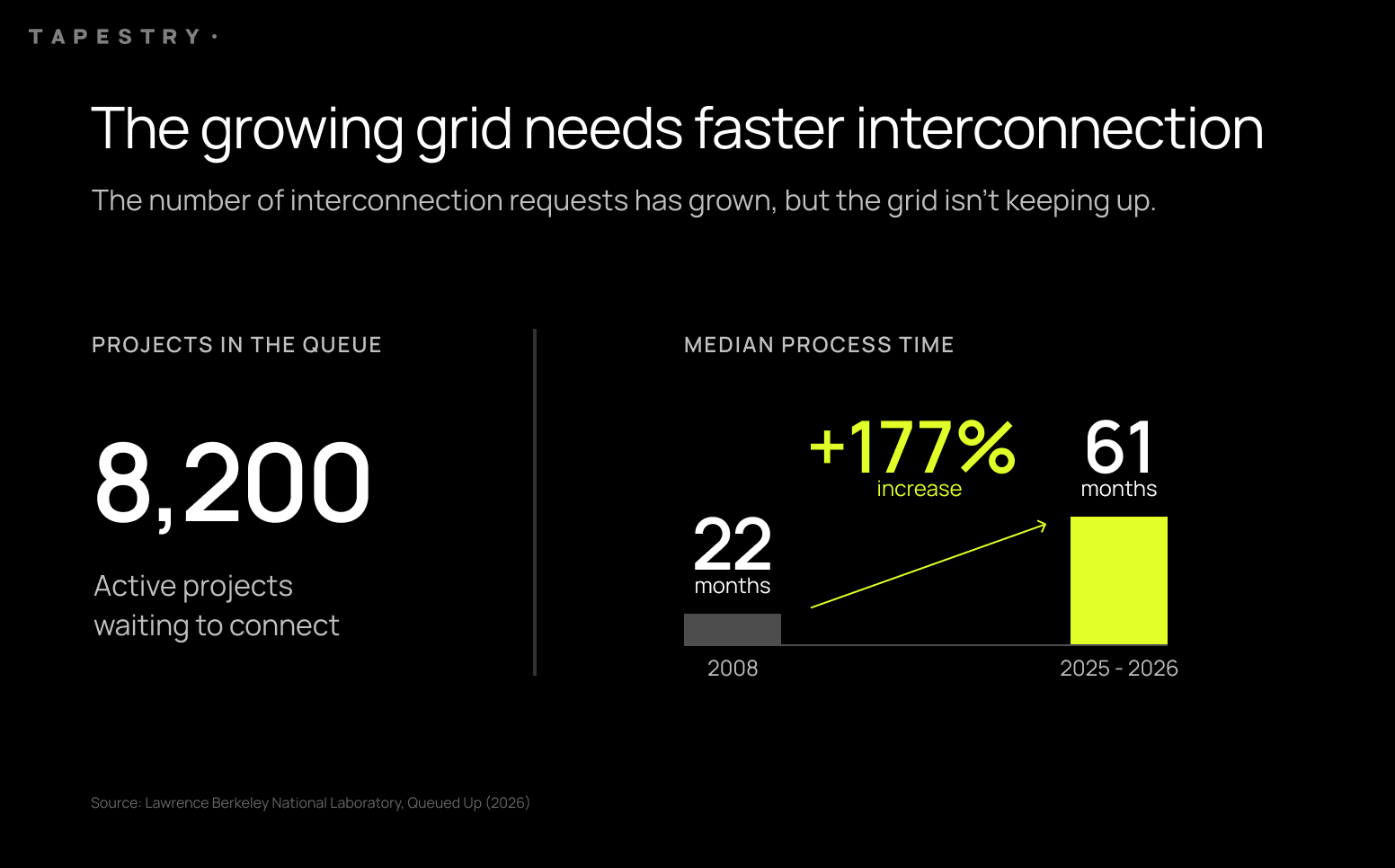
Part of that backlog comes down to process: until recently, engineers reviewed interconnection applications by hand, one at a time, at a pace surging demand has outrun. The queue also contains speculative projects that linger in the process and are only removed when applicants proactively drop out of the queue at various decision points or fail to meet requirements like site control. The power sector can be slow to adopt new processes. For example, innovative transmission developers can identify locations where advanced transmission technologies can significantly alleviate grid congestion, including reconductoring transmission lines to let more current flow through or adopting dynamic line ratings to enable more line capacity based on real-time environmental conditions.
These trends are converging to create a uniquely challenging set of circumstances.
When combined with fragmented policies, rules and procedures across the federal and state levels, individual service territories and organizations, the additional technical analysis needed to address the rapidly transforming grid now limits what the grid and its planners and operators can undertake. Put differently, the status quo is making an already difficult analytical problem even more challenging.
Policymakers are calling for bold changes in the power sector
Policymakers are acting. Since 2022, several Congresses have taken up permitting reform, and on September 30, a bipartisan group of Senators released new text that includes several new grid and transmission policies, notably a section on grid data access (Bipartisan American Affordability and Jobs Act, § 2111). As the public deliberates the package’s broader impacts, the grid data access provisions target how grid data silos currently limit the ability of grid actors to plan and operate collaboratively and effectively and will remove that barrier going forward.
On June 18, 2026, FERC issued six “show cause” orders under Section 206 of the Federal Power Act, one to each jurisdictional grid operator and its transmission owners, directing each region either to justify why its rules remain just and reasonable without clear and consistent provisions for large load interconnection—or to propose revisions. Rather than impose a uniform national rule, FERC identified five categories of reforms: (1) efficient transmission service application and study processes, including consideration of alternative transmission technologies; (2) cost-shift protections and transparency requirements for transmission costs; (3) accommodation of co-location agreements and behind-the-meter generation; (4) new transmission services for flexible large loads; and (5) a process to study generating facilities that serve electrically proximate and co-located large loads.
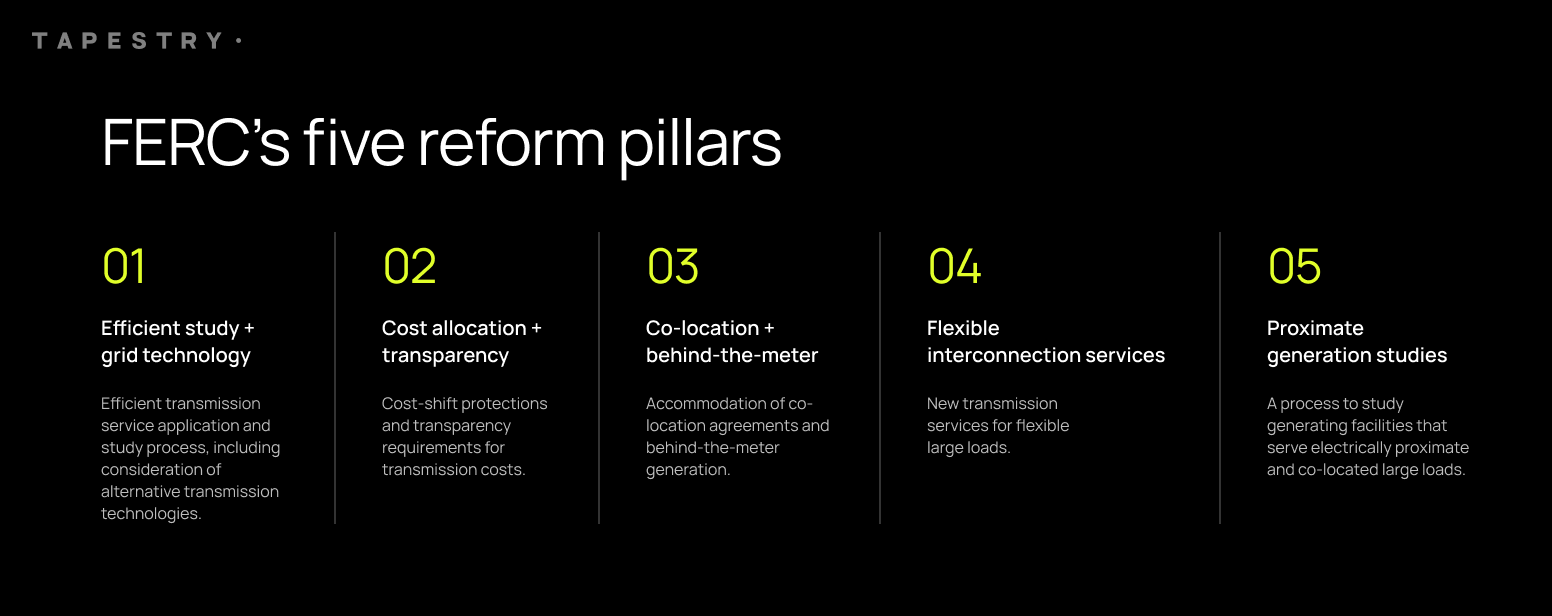
The orders followed the Secretary of Energy’s October 23, 2025, directive to FERC on large load integration. Each region has until November 2026 to respond to FERC’s show cause orders. Meanwhile, regions continue to implement FERC’s generator interconnection reforms from Order No. 2023, while recognizing that generator and load interconnection processes may need closer coordination over time.
What happens to the grid in the next five years will decide whether the American energy system — and the economy that depends on it — thrives for decades. Without the right support and focus, the policy changes, market developments and technologies the grid needs may not materialize when it and the communities it serves are most vulnerable. Below, we set a vision for how technology helps transform constraints into opportunities for the grid, explain the technical and data barriers to adoption, and show what becomes possible once those barriers fall.
This is a time for transformational improvements, not incremental progress.
Tapestry’s vision: The true grid upgrade requires data and collaboration
The complexity of the grid’s data and analytical requirements now mirrors the complexity of its physics; both are increasingly dynamic and vital to its current and future functionality. Going forward, we need to broaden and deepen the usefulness of that data layer for planners and operators so that the grid continues meeting high standards of reliability and security while delivering more affordability for its users.
Tapestry is building that grid information upgrade by creating a collaborative platform that operates on a foundation of grid data and powerful computational capabilities to arm grid experts with the insights and tools they need more than ever before.
We are solving for usefulness in three ways:
- First, Tapestry focuses on making data actionable while retaining its detail and truth throughout all of our tools and use cases. That requires ensuring it is complete, accurate, current, interoperable, accessible, and secure.
- Second, Tapestry focuses on the individual user of that data, giving each one access to easy-to-use, fast computational tools that amplify their expertise and make their workflows more efficient.
- Third, Tapestry brings those two elements together to inform and change how engineers and experts at RTOs, TOs, developers, and other grid organizations work together. Shared data and tools make this collaboration possible, and the need for it across workflows, models, and process steps has never been more pressing.
With these focal points guiding us, we are building a unified platform for collaboration and data integrity. Our platform draws high-fidelity insights from the operational level through to planning exercises. It brings all parties of the interconnection process into real-time conversation about a single model in which edits are tracked as collaborators synthesize and share new sources of information. Tapestry’s platform stages a location for other partners to build as well, and going forward, we will add analytical tools that are capable of evaluating grid behavior from microseconds to decades.
Tapestry’s unified platform removes data and communication silos by its very nature. Its analytical engines will organize and track the countless bits of data now bombarding engineers or getting lost in transit from one grid organization to another, transforming them into legible tools for operational and planning decision-makers.
Soon, the transmission owner engineer editing a model file with frequent updates from developers will log in, see their counterpart’s single-source model, edit it, ping the model owner with updates and confer with the developer as well to prevent inconsistencies. On the operations team, colleagues will track and relay violation updates in the same model manager, and in turn, see into the planning future grounded in the same physical representations and detailed understanding of how equipment will perform amid external stress.
The computational abilities Tapestry has developed let operational-level data granularity inform interconnection decisions and long-term planning. This does not mean rolling up estimates from averaged data points. We have the tools to pull fidelity from the smallest timescales up to the longest, optimize computation run time and harness pragmatic AI to guide us through analytical steps and calculations that otherwise would have bogged down our most talented engineers and limited the number of outcomes that can be evaluated.
Tapestry’s vision is to situate the physical facts of the grid in the economic, policy and technological demands of our dynamic time while making the grid’s decision points actionable and inviting its decision-makers to collaborate.
Why lack of data interoperability is an obstacle to this vision
This vision is within reach, but the tools we and other industry partners are building still face obstacles, and many of them start with grid data.
Considering the data points now emerging across the grid, the amount, timing, and detail of information present an overwhelming task for its operators and planners. As data transfers from equipment to analyst, several obstacles may arise that limit its usefulness. If short-circuit and contingency studies miss breaker ratings, relay trip times, and protection sequencing, engineers cannot determine whether a fault will clear or cascade. Incomplete asset and topology data undermine the ability of power flow software to solve because nodes appear ungrounded. Grid data completeness must now extend to the component level to provide engineers the full picture.
Grid data must also be accurate and current. Compliance rules establish a floor rather than a shared operating model. NERC sets modeling data requirements and reporting procedures for planning through its MOD-032 standard, but it only requires TOs to share models on an annual basis. The lack of more timely data updates inevitably leads to models that do not track physical changes within that reporting timeframe. NERC FAC-008 reliability standards govern facility-rating methodology and how ratings are set and communicated. In practice, data can often be maintained to meet those requirements in separate systems, then manually updated elsewhere to keep models in sync. Engineers stop midway through studies to request data updates from other parties, but chasing accurate and current information opens data work streams to errors that propagate, models that differ among grid actors, and costly time sinks instead of cost-saving analysis. The timeline and detail level of data matter immensely in the cost estimations of grid upgrades, and improvements in these data attributes ultimately translate to cost clarity and affordability for grid customers as a whole.
In its show cause orders, FERC calls out EMT simulations as essential to understanding the operational attributes of large loads and IBRs. Producing sub-second analysis of sub-cycle electrical phenomena, including waveforms, control dynamics, interactions among IBRs, and voltage and frequency disturbances, EMT visualizes the operations of power electronics-driven equipment and resources and offers engineers deep insights into their impact on the grid. Because their equipment depends on power electronics, original IBR manufacturers protect their control code, offering it in “black-box” file formats that function with a limited set of simulators or converters. As utilities and regulatory bodies begin to require the submission of equipment-level EMT models for interconnection studies, the proprietary nature of the file format becomes a stumbling block for data interoperability and limits the ability of engineers to harvest greater insight about potential IBR-based violations. That can limit the use of faster or different simulation tools and add time to the study process.
The status quo for grid data security
NERC Critical Infrastructure Protection standards and the administration of CEII rely on non-disclosure agreements as one of several checkpoints for actors to obtain and use grid data, models, and other protected information, largely via point-to-point file transfers. The CIP and CEII systems lack uniform interpretations across regions, resulting in data being subject to varying levels of restriction, redaction, and non-disclosure requirements. Without developing modern systems to securely share and analyze grid data, the power sector risks deepening existing data silos under ambiguous security designations while increasing individual organizations' vulnerability. Security risk is not a static boundary that access denials and nondisclosure agreements alone can enforce, and the tradeoff of adhering to this legacy approach is severely restricted data accessibility and interoperability.
Responsible entities and grid planners evaluate operational and reliability risks, categorizing essential assets as high-, medium-, or low-impact bulk electric system cyber systems under NERC CIP-002 standards. This categorization requires utilities and transmission operators to enforce rigorous cybersecurity protections to prevent unauthorized access to sensitive grid assets. Corresponding BES Cyber System Information is governed under strict access controls, secure storage, and defined disposal requirements (e.g., under CIP-011). These protections apply specifically to information that could grant an attacker a material operational advantage—such as network architecture diagrams, access control lists, and security configuration files—while broader planning studies (such as regional transmission expansion plans) that do not expose sensitive asset vulnerabilities remain unencumbered. The growing importance of grid data has revealed that it must be complete, current, accurate, accessible, interoperable, and secure to be useful to the experts conducting studies, models, and operational and planning activities. Much of this data exists, but how users currently access and exchange it, within or across organizations, exposes it to security vulnerabilities, planning and workflow delays, and inaccuracies that propagate and compound across the system.
Why we need better coordination and validation for the grid as a whole
Although data increasingly reflects the grid’s physics in timescale and granularity, the industry’s practices to validate, communicate, and use data distort it, frequently rendering it useless or making the grid vulnerable to violations. Grid models have supported reliable planning and operations, but they often rely on approximations in place of detailed asset data. As more developers apply and more equipment connects, it becomes increasingly challenging for individual engineers to capture, track, update, and correct approximations or errors that propagate across studies and models, obscuring data sources and physical system conditions. Additionally, approximations or simplifications can translate to expanded safety margins to compensate for uncertainty, potentially leading to unnecessary reduction in grid utilization overall.
Grid engineers encounter these problems on a daily basis. Each software program generates its own file format, which is its own model of the grid. When something changes in one model, the change has to be applied manually to models controlled by other grid actors.
- Consider a hypothetical: a generator enters the interconnection queue, and the RTO assigns it a placeholder bus number. The project advances, the TO renumbers it into its own range, and an engineer updates the power flow model. The short-circuit model still has the old number. From that point, the two tools describe the same machine under different names, potentially leading to miscoordination, miscalculated protection settings, and reliability risks.
- In another hypothetical, the TO and the RTO model the same territory using different topological frameworks: the RTO uses a detailed node-breaker representation for real-time operations, while the TO uses a simplified bus-branch representation for planning. To merge them, an engineer must group nodes by hand to stand in for a substation so the other tool will accept the model.
Within a single organization, the planning team often works in one power flow package, the operations team works in energy management and SCADA systems, and short-circuit data lives in a third tool. Asset details are spread across GIS, single-line diagrams, and asset management systems. Many organizations lack a common data source or automated way to map and reconcile these systems.
Within an RTO, planning and operations teams appropriately maintain models for different purposes and update them on different cycles. Those models reflect different assumptions, equipment status, or project information. When a correction affects several teams or systems, resolving it can require coordination across organizations and study processes. Nothing propagates the update automatically to those who need accurate information. Sharing data, including model edits, between a TO and an RTO is harder, because each may run a different system, choose to retain data, and use formats that require conversion or licensing to confer legibility.
The problem compounds across regions. Neighboring grid operators may use different sets of tools and processes. Developers working in multiple regions must adapt to each region’s software, data formats, and study practices. Each adaptation costs time: a clean base case in a single region could take a team of a dozen engineers over three months to assemble. A developer entering a second region starts that process over. In other words, there is no universally adopted toolset or study convention that lets a project move seamlessly among markets.
The grid’s analytical landscape currently lacks coordination and transparency.
Interconnection and planning require a series of data and model handoffs, each adding complexity. A grid operator updates the interconnection study model with generation models provided by developers, then shares it with TOs that may maintain more accurate representations of the system within their territories. The TOs add their load profiles, including information from large load developers, and other corrections before the model returns for further study. Every step takes time and creates opportunities for assumptions, project data, and model versions to diverge. The pace of change and amount of information affecting the grid no longer matches the update rate providing a current, complete view of all relevant inputs, meaning that few actors obtain accurate insights at any given time.
Projects can also move faster than the coordination around them. TOs and grid operators still exchange short-circuit reports, grid changes, and project information through emails, spreadsheets, shared file repositories, and manual review. A task requiring limited engineering time might become a multi-step coordination process lasting weeks as parties exchange files, comments, corrections, and approvals.
That process also creates recurring data quality problems. An error identified in a study model is corrected in one case but not in the underlying source record or related cases. The same error can then resurface during a later model update, forcing another round of investigation and rework, a Groundhog Day cycle of correcting the same issue without resolving it at its source. Moreover, transferring files and storing them across multiple locations and access points exposes sensitive and CEII data to risks from external threats or misuse.
TOs commonly perform much of the local engineering needed to turn a study result into a buildable project. That work can include reviewing stability and dynamic studies, confirming that equipment data and single-line diagrams align with the relevant model, developing cost estimates, and executing upgrades. Late or incomplete information can delay facility studies, change an interconnection result, or push work into a later planning cycle. Incorrect or missing data also leads to overly conservative planning that drives unnecessary and expensive network upgrades.
Secure, controlled access to the same version of current information and a practical way for authorized participants to work from the same system conditions are missing.
The value of a unified platform and full data interoperability
A unified platform can do more
There is a single, physical grid but many digital representations of it, each built for individual tasks. These systems exchange information through manual or point-to-point processes, instead of through a shared model layer.
Tapestry’s platform will bring grid data, the people who use it, and the studies they run onto a common foundation. It will support secure model editing and version control, the use of selected operational information in planning, time-series analysis, and additional information drawn from the real world to inform grid analysis and planning.
Power-system engineering will continue to require specialized tools, and a unified platform does not replace them. Tapestry’s collaborative platform will enable partners to plug in the tools they rely on or have developed by integrating broadly available and interoperable data formats. Put differently, the goal is to preserve what works while improving what does not.
The practical applications of a unified platform
Grid-planning engineers need a collaborative platform that unifies spatial information with six capabilities:
- Connecting electrical topology with GIS coordinates for lines, transformers, and substations, subject to data availability and access controls;
- Connecting network data with relevant operational metadata, such as equipment condition, planned outage dates, ratings, and historical loading;
- Linking related seasonal, annual, and scenario-based study cases across time so when an assumed in-service date for an upgrade changes, the system identifies related cases that may require review and presents proposed updates for validation and approval;
- Supporting exchange among steady-state power-flow and stability studies, short-circuit and protection analysis, distribution studies, and EMT analysis, where models and formats can be translated and validated;
- Maintaining relationships among detailed node-breaker models and simplified bus-branch or zonal equivalents that allow engineers to move between bulk-power analysis and local substation detail without rebuilding each representation from scratch; and
- Maintaining an approved planning record while allowing participants to work in controlled copies for analysis, testing, and work in progress.
Protecting sensitive data
Grid models contain CEII data, as well as proprietary operational, project, and equipment parameters. Any shared or multi-party environment must protect this information through strict access controls, cryptographic safeguards, and governance tailored to data sensitivity aligned with appropriate standards. Grid data owners define precise permissions and data-sharing agreements, ensuring authorized participants receive only the least-privilege information necessary to perform their approved roles.
The same principle protects proprietary equipment models and vendor technology: a secure, shared environment allows authorized participants to simulate equipment behavior and execute power-flow studies while original equipment manufacturers maintain full custody and control over their proprietary intellectual property, subject to validated technical agreements between the vendor and the system owner.
A modernized compliance and cloud security baseline
Today, Tapestry modernizes the power sector’s cybersecurity posture by replacing ad-hoc, point-to-point file exchanges (such as unmonitored spreadsheets) with a centralized, version-controlled collaborative platform. Operating under a formal shared responsibility model, Tapestry is hosted on Cloud Service Provider infrastructure that maintains audited FedRAMP High, ISO/IEC 27001, and SOC 2 Type II certifications. At the application and platform layers, Tapestry’s Information Security Management System aligns with NIST SP 800-53, NIST SP 800-171 Rev 3, and the DOE Cybersecurity Capability Maturity Model (C2M2 v2.1), and is actively undergoing its independent ISO/IEC 27001 and SOC 2 Type II audits. This architecture ensures that rapid, multi-party interconnection and transmission studies required by FERC protect the physical reliability, data integrity, and confidentiality of the BES.
Zero-trust architecture and perimeter defense
To defend critical grid data and operational telemetry, Tapestry enforces an active zero-trust and "assume breach" defense characterized by strict isolation over traditional network perimeters:
- Enclave and network isolation: Sensitive grid assets (Class B CEII) are partitioned into dedicated enclaves provisioned via Infrastructure-as-Code and enclosed by virtual private cloud service controls perimeters. These perimeters enforce default-deny egress, isolate private datastores from public internet exposure, and restrict data residency exclusively to customer-designated geographic regions (e.g., domestic U.S. data centers for CEII).
- Federated identity and least-privilege access: External utility and agency personnel authenticate via federated enterprise Single Sign-On, inheriting their organization’s mandated multi-factor credentials (such as PIV/CAC cards) without storing third-party credentials in Tapestry databases. Fine-grained resource access is evaluated dynamically at runtime using Attribute-Based Access Control and need-to-know principles. Internally, standing human production access is strictly prohibited in favor of time-bound, multi-party approved Access-on-Demand.
- Cryptographic key custody: For regulated and sovereign workloads, Tapestry establishes cryptographic sovereignty by supporting Customer-Managed Encryption Keys via centralized Key Management Services, ensuring utility partners maintain sole custody over decryption rights and preventing unauthorized third-party disclosure.
- Secure Analytical Execution: Tapestry’s dedicated Analytical Hub isolates machine learning pipelines and complex grid simulations using ephemeral, read-only compute environments, preventing cross-partner data co-mingling and excluding personally identifiable information.
- Continuous supply chain and security information and event management auditability: Platform deployments enforce continuous supply-chain security, including automated software bills of materials, continuous vulnerability monitoring, and 365-day immutable audit logging exported to a dedicated security information and event management platform (Google Security Operations) for continuous threat detection and compliance auditing.
A platform will empower grid planners to expand an affordable grid.
A unified platform may be the best grid planning tool for grid operators and transmission developers to manage the volume of new transmission capacity that our grid needs in the coming decades. Transmission planners can make better decisions because they know exactly what equipment they are working with, that the data about the equipment is up to date, and that they can rely on it without cross-checking other sources. A platform will allow planners to understand probabilistic instead of only deterministic outcomes, significantly improving their ability to estimate the cost and impact of any grid addition. Accessing probabilistic understanding also improves risk evaluation when modeling an energy network for which there is no physical precedent or deterministic model.
Likewise, a unified platform can unlock a market for the best grid additions. Instead of having to find a site, wait six to eight weeks for utility analysis and then iterate to another site, developers can quickly see where they can get faster speed to power and lower cost (and what it would take). Put differently, the right data platform allows holistic innovations like buying airline tickets on your phone instead of having to go to a travel agent or calling each airline individually.
A unified platform will unlock the potential of hourly analysis and ATTs.
Many planning workflows use seasonal peak cases and selected planning horizons. A worst-case condition may occur during only a few hours of the year. With precaution for those outcomes in mind, grid operations teams build the system with a buffer for those scenarios. Static cases can also miss the interactions among IBRs.
Simulating all 8,760 hours in a year can help planners test flexible-load behavior and generation dispatch across many operating states. Hourly analysis supplements static assumptions with physics-based assessments of hidden capacity that enhances planning and operations without undermining or obviating the need for reliability criteria and good judgment. By providing more information about operational behavior throughout the year, 8,760 analysis aids the pursuit of flexible operations, siting new generation or load, and delivering consumer savings. Despite efforts made by FERC to encourage their adoption, ATTs provide solutions to the grid by identifying and harnessing changing external or grid-based physical conditions, such as weather-related thermal changes or shifts in system topologies. Because ATTs rely on changes to the grid to identify opportunities to better utilize it, they often also depend on high-fidelity data and analytics while also interacting with traditional planning tools to find and use hidden capacity.
A unified platform will aid grid actors to identify hidden capacity, support more coordinated study of generation and large loads, bring selected operational information into planning, and enable planners to evaluate dynamic capacity, flexible loads and ATTs before committing to conventional infrastructure upgrades. Planners would keep the margins and reliability criteria operators rely on, while time-varying system information will provide a stronger basis for planning than fixed assumptions alone.
Looking ahead
Edison’s first grids were local and limited, but his premise was durable: electricity worked because its parts worked together.
Nearly a century and a half later, the grid stretches across regions, markets, technologies, and institutions Edison couldn’t have imagined. Its physical infrastructure grew to enable economies and communities to flourish while maintaining reliable operations, but its information systems haven’t kept up with recent advancements or hastening change. With the expertise and computational tools available today, the original architects of the electric grid might have designed it differently and certainly would have made sure the data needed for interconnection, planning, and operation was legible and accessible.
Policymakers have recognized that the grid is a single machine and aimed the entire power sector toward that reality. Congress and regulators are calling for action, and industry now has a chance to catch up and answer those questions. To do so, the industry needs timely, controlled access to data, innovative software tools to analyze it, and working, collaborative processes that put the new rules into practice.
That will take time. Engineers and operators need to test new tools against the systems they know and see where they work. They’ll keep the reliability practices and judgment that have made the grid dependable. But they also need better ways to see changing conditions, work across organizational lines and plan for the system that’s arriving rather than the one they inherited.
Much of the technology needed for that next step already exists or is within reach. The work now is to create the technical and regulatory conditions that allow the industry to use it responsibly and at scale.
Contributors

General Manager
Page Crahan
A longtime leader in the energy space, Page bridges technical depth and commercial execution across physical infrastructure and frontier technology. Prior to Alphabet, she built a track record scaling high-growth energy startups, including as co-founder and CEO of Clarus Power. She held leadership roles in both go-to-market and commercial innovation at SunRun, helping steer the company’s growth through its initial public offering. A co-inventor on multiple U.S. energy patents, Page serves on the Washington Post’s Intelligence AI & Tech Council and the Santa Clara University Tech Ethics Council.

Head of Technical and Partner Operations
Andy Ott
Andy is an internationally recognized expert in electricity market design and power system operation. Prior to joining Tapestry, he served as President and CEO of PJM Interconnection, the largest power grid in North America and the largest electricity market in the world. He has extensive experience in power system engineering, transmission planning, applied mathematics, electricity market design, and implementation. Andy is an IEEE Fellow and an Honorary Member of CIGRE, and he served as co-chair of the Energy Transition Forum for 8 years.

Public Policy Lead
Luke Bassett
Luke spent years navigating energy policy across Capitol Hill, the Executive Branch, and think tanks before joining Tapestry. Now, he’s bringing Tapestry's grid AI tools back to D.C. and beyond. A native West Virginian, he’s most at home skiing or hiking mountain trails.

Chief of Staff
Brandon Belford
Brandon sets the operating rhythm for Tapestry and strategic plan for commercially scaling the business. When he and his wife are not chasing around his daughters, he’s investing in and advising global football clubs.

Product Manager
Natalie Cothenet
Natalie's product management work has her seeking out solutions to speed up the interconnection queue, better manage grid models, and develop a Tapestry platform. She balances her enthusiasm for clean energy with a love of epic backpacking adventures.

Principal Partnerships Program Manager
Colin Law
Colin's professional mission is speeding up grid interconnection. His personal mission? Speeding down mountains on telemark skis and visiting every type of power plant.

Power Systems Specialist
Shengnan Shao
Shengnan is a seasoned power system planning engineer dedicated to building the future grid, where AI both powers and is powered by the grid. When she's not at work, you can find her reading, hiking, snorkeling, or riding roller coasters with her family.

Head of Partnerships
Aviva Shwaid
When Aviva isn’t powering up our partnerships, you can find her amped up for a game of pickleball. She is also a fan of electrical grid puns.

Head of Power Systems and Technical Operations
Cat Wong
Cat balances her passion for technology and leadership with a love for travel and cultural exploration.

Product Manager
Joyce Yao
As a product manager in grid operations, Joyce chases cleaner lines—whether for megawatts on the electric grid or on her mountain bike trails. To her, one helps preserve the other.